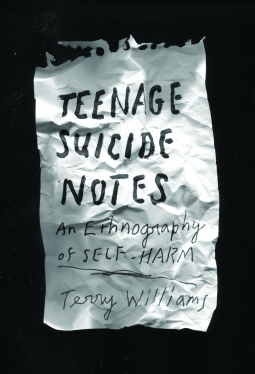

In Teenage Suicide Notes Williams elucidates a subject many prefer to ignore, to pretend it doesn’t exist. But exist it does, and it’s growing worse. And what is that subject?
Teenage suicide.
Williams makes an ethnographic study of several teens in New York who either committed suicide, or went through parasuicide rituals. Many of these teens were thankfully either able to work through the underlying issues or were well on the way to doing so. Two weren’t so blessed. For them, the only way out was that final step. This book contains only a handful of cases, yet it encompasses the truth of a wide swath of our communities.
This ethnographic study put paid to the notion that a two-parent household was ideal. Even two-parent homes can be full of dysfunction, with faulty beliefs and behaviours passing from generation to generation, at least until someone along the line becomes self-aware enough to break the cycle. The biggest issue was these kids being the odd one out in the family, and trying to conform to expectations. Like a square peg trying to fit in a round hole.

This book really struck a chord with me. I was the ‘black sheep’ of my family, so different from everyone else. I had suicidal thoughts as a young adult and teen. I didn’t fit in at school either, being an extreme introvert. I was more at home in books than with people.
I wrote about suicide, like the kids within these pages, but never made a serious attempt. I’m forever grateful to my paternal grandmother, who always accepted me as is, even when my faith diverted from my family’s. I became deeply spiritual, and philosophical, a far cry from the majority of my family. They still cannot understand me, but we’ve come to accord, and my relationships are much improved.
I still have unhealthy inculcated beliefs, those multi-generational influences passed down from parent to child. This has left me with a deep distrust of males, among other things. I’ve spent decades working through these limiting beliefs. Perspective changes everything.
I find it fascinating, the notion of suicide and suicide attempts as a rite of passage in America, in a culture that has no formal rites of passage. Williams notes that teens today seem to be finding their way back to the rites of passage to adulthood practised by older societies, where said rites involved undergoing risks in order to become adults. What our ancestors did in a controlled, purposeful way, with the support of the adult community, today’s teens are doing themselves, albeit uncontrolled and unsupported. Perhaps society as a whole needs to heed the wisdom of our ancestors.
This is a book I would recommend everyone read. This is such an important topic, and one many avoid.
***Many thanks to Netgalley and Columbia University Press for providing an egalley in exchange for a fair and honest review.
